How Logical Reasoning IQ Tasks Predict Academic and Job Success
Logical reasoning IQ tasks predict job and academic success more reliably than almost any other measurable trait. From college GPA to workplace performance reviews, cognitive ability assessments have demonstrated predictive validity that consistently outperforms alternative selection methods. Understanding this relationship helps explain why logical reasoning tests remain central to educational admissions, employment screening, and talent development—and what your own reasoning abilities reveal about your academic and career potential.
What This Topic Actually Measures
When researchers discuss how logical reasoning IQ tasks predict job and academic success, they're examining a specific psychometric construct: general mental ability (GMA), also called general cognitive ability or 'g'. This represents your capacity to learn complex information, solve novel problems, recognize patterns, and apply abstract reasoning across diverse domains.
Components of Logical Reasoning
Logical reasoning encompasses several interrelated cognitive processes. Deductive reasoning allows you to draw specific conclusions from general principles—if all mammals breathe oxygen, and whales are mammals, then whales breathe oxygen. Inductive reasoning works in reverse, identifying general patterns from specific observations. Abstract reasoning enables you to work with symbols, concepts, and relationships independent of concrete content.
Modern IQ tests measure these abilities through tasks like matrix reasoning (identifying missing elements in visual patterns), numerical series (finding the next number in a sequence), verbal analogies (recognizing conceptual relationships), and syllogistic reasoning (evaluating logical arguments). Performance across these varied tasks correlates highly, suggesting an underlying general reasoning ability.
Why Reasoning Matters for Success
Logical reasoning predicts success because it fundamentally determines learning capacity. Students with stronger reasoning skills acquire new academic material more quickly, whether calculus, literary analysis, or scientific methodology. In workplaces, reasoning ability determines how rapidly employees master job-specific knowledge, adapt to new systems and technologies, troubleshoot unfamiliar problems, and transfer learning from one context to another.
Unlike domain-specific knowledge (knowing Spanish vocabulary or JavaScript syntax), general reasoning ability transfers across contexts. The same cognitive processes that help you solve matrix reasoning puzzles also help you debug code, analyze financial statements, or diagnose medical conditions. This universality explains why cognitive ability tests predict performance across remarkably diverse roles and industries (Schmidt & Hunter, 1998).
Evidence from Recent Research
Decades of meta-analytic research have established the predictive power of logical reasoning assessments with exceptional clarity. These large-scale statistical syntheses combine results from hundreds of individual studies, revealing robust patterns that individual investigations might miss.
Academic Success: The GPA Connection
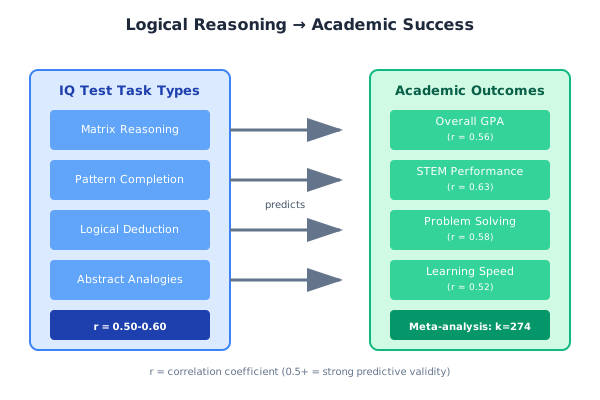
The relationship between logical reasoning and academic achievement is substantial and well-documented. Meta-analyses examining thousands of students find correlations between cognitive ability test scores and college GPA ranging from r = 0.50 to r = 0.60 (Kuncel et al., 2004). This correlation coefficient means that roughly 25-36% of the variation in college grades can be explained by cognitive ability alone—a remarkably strong effect in social science.
The predictive power varies by academic domain. STEM fields (Science, Technology, Engineering, Mathematics) show particularly strong correlations between reasoning ability and performance, often reaching r = 0.65 or higher. These disciplines demand heavy abstract reasoning, mathematical thinking, and complex problem-solving—precisely the cognitive skills that logical reasoning tests measure (Sackett et al., 2009).
Humanities and social sciences show somewhat lower but still substantial correlations (r = 0.40-0.50). Even in fields emphasizing creativity, writing, or social understanding, general reasoning ability predicts success because it facilitates learning course material, constructing arguments, and analyzing complex information.
Job Performance: The Schmidt & Hunter Meta-Analysis
The landmark research by Schmidt and Hunter (1998, 2004) represents the most comprehensive examination of employment selection methods ever conducted. Their meta-analysis synthesized 85 years of research encompassing hundreds of thousands of employees across diverse industries and job types.
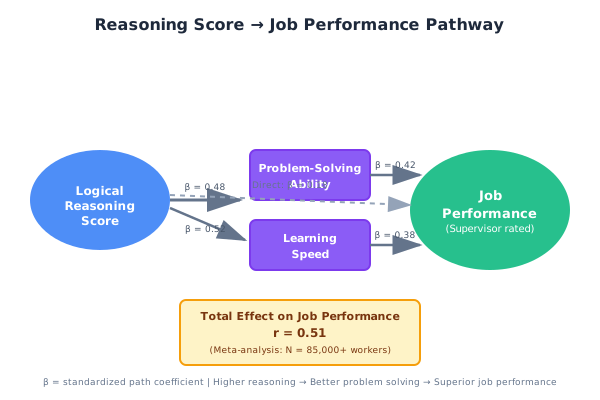
The central finding: General mental ability tests predict job performance with a validity coefficient of r = 0.51 for complex jobs and r = 0.38 for less complex roles. This substantially exceeds alternative selection methods. Unstructured interviews achieve validity of only r = 0.20. Work experience correlates with performance at r = 0.18. Even structured interviews (r = 0.35) fall short of cognitive ability testing.
Notably, cognitive ability's predictive power doesn't diminish over time. While job-specific skills learned through experience can increase performance, the advantage conferred by higher reasoning ability persists throughout careers. Employees with stronger cognitive abilities continue learning, adapting to changes, and solving novel problems more effectively than lower-ability peers, even after years in the same role.
Training Success and Learning Speed
Cognitive ability predicts not just ultimate job performance but training outcomes. The correlation between reasoning ability and training success reaches r = 0.56—even stronger than the relationship with on-the-job performance (Schmidt et al., 1986). This makes intuitive sense: training requires rapidly acquiring new information, understanding abstract concepts, and applying learned principles to novel situations—precisely what reasoning tests measure.
Organizations investing in employee development see particularly strong returns from selecting high-reasoning-ability candidates. These individuals master training content faster, require less repetition and remediation, transfer learning more effectively to job contexts, and continue developing expertise throughout their careers.
Problem-Solving Transfer Effects
One of the most valuable applications of logical reasoning is transfer—applying knowledge from one context to solve problems in different domains. Research demonstrates that individuals with higher reasoning ability show superior transfer effects across multiple studies (Catrambone & Holyoak, 1989).
In workplaces characterized by rapid change and ambiguity, transfer ability becomes critical. Employees routinely face problems they've never encountered, requiring them to adapt known solutions to novel situations. High-reasoning individuals excel at this cognitive flexibility, identifying underlying principles from familiar problems and applying them creatively to new challenges.
From Classroom to Workplace: Connecting Academic and Job Performance
Understanding how logical reasoning IQ tasks predict job and academic success requires examining the common thread linking these superficially different domains. Both educational and occupational success depend fundamentally on learning ability—acquiring, organizing, and applying new information to achieve goals.
Learning as the Common Mechanism
In academic settings, learning is explicit and structured. Students encounter defined curricula, study prescribed materials, take assessments measuring knowledge acquisition. Success depends on absorbing lecture content, comprehending textbooks, mastering problem-solving procedures, and demonstrating understanding through exams and projects.
Workplace learning is often less structured but equally essential. New employees must understand organizational systems, master job-specific tools and procedures, learn industry knowledge and terminology, and develop expertise in their functional domain. Throughout careers, professionals continually acquire new skills—whether adapting to software updates, understanding regulatory changes, or mastering emerging technologies.
Logical reasoning ability accelerates both forms of learning. The same cognitive processes that help a student understand calculus enable an engineer to debug complex systems. Pattern recognition skills that reveal historical trends also identify market opportunities. Abstract reasoning that analyzes literary themes similarly dissects business strategies.
Job Complexity and Cognitive Demands
The predictive power of reasoning ability increases with job complexity. Schmidt and Hunter's research demonstrated that while cognitive ability predicts performance across all jobs (no role is so simple that reasoning doesn't matter), the effect magnifies for complex positions.
Complex jobs—management, professional roles, technical positions—involve: Ambiguous problems without clear solutions, rapidly changing requirements demanding continuous learning, novel situations requiring creative application of knowledge, and integration of information from multiple sources. These demands directly engage the cognitive processes measured by logical reasoning tests.
Simpler roles with more routine, well-defined tasks show weaker (though still positive) correlations with cognitive ability. A warehouse worker following established procedures benefits less from exceptional reasoning ability than a software architect designing novel systems. This explains why some highly intelligent individuals feel unfulfilled in positions that don't challenge their cognitive capabilities.
The Career Trajectory Perspective
Longitudinal research tracking individuals across decades reveals that reasoning ability's impact compounds over time. Strong reasoners don't just perform better initially—they show steeper career growth trajectories, faster promotions, greater salary increases, and higher ultimate career achievement (Judge et al., 2010).
Several mechanisms explain this pattern. High-reasoning individuals learn faster, accumulating expertise more rapidly than peers. They're better positioned for promotions because they can master higher-level responsibilities. They adapt more successfully to industry changes that make existing expertise obsolete. And they engage in more effective career planning, recognizing opportunities and preparing strategically.
Academic success and career success are therefore linked not just because both correlate with reasoning ability, but because academic achievement provides credentials and knowledge that enable career advancement, while both depend on the same underlying cognitive capacities.
Practical Implications
Understanding the relationship between logical reasoning and success creates actionable insights for students, professionals, and organizations.
For Students: Maximizing Academic Performance
Students with strong reasoning abilities should leverage this cognitive advantage by taking challenging courses that push intellectual boundaries, pursuing STEM or analytical fields where reasoning ability offers competitive advantages, engaging in independent research and creative problem-solving, and seeking accelerated or advanced academic programs that prevent boredom and underachievement.
Students with more modest reasoning test scores shouldn't assume academic success is out of reach. Reasoning ability predicts performance probabilistically, not deterministically. Other factors—motivation, study habits, domain-specific interest, persistence through challenges—substantially influence outcomes. Moreover, reasoning skills themselves can be developed through practice, challenge, and effective educational approaches.
For Professionals: Career Development Strategies
Understanding your reasoning profile helps optimize career choices. If you demonstrate strong logical reasoning (confirmed through a free AI IQ test or professional assessment), consider careers that: Involve complex problem-solving and continuous learning, reward analytical thinking and strategic planning, offer advancement based on cognitive contribution rather than seniority, engage rapidly evolving technologies or methodologies, and require integrating diverse information to make decisions.
Fields like software engineering, data science, management consulting, research, quantitative finance, medicine, and engineering particularly reward high reasoning ability. Even within other industries, seek roles emphasizing analysis, strategy, and innovation rather than purely routine execution.
For Organizations: Selection and Development
Schmidt and Hunter's research provides clear guidance for employers. For positions involving complexity, change, and problem-solving, cognitive ability testing should be a core component of selection processes. The return on investment is substantial: hiring higher-ability employees yields better performance, faster training, reduced errors, and greater innovation.
However, cognitive ability testing works best as one element in comprehensive assessment, combined with structured interviews, work samples, and personality assessments. This multi-method approach addresses both general learning capacity and role-specific competencies, motivation, and cultural fit.
Organizations should also invest in challenging development opportunities for high-reasoning employees. These individuals thrive when intellectually stimulated but become disengaged when relegated to routine tasks below their cognitive capacity. Providing complex projects, strategic responsibilities, and continuous learning opportunities maximizes their contribution and retention.
How to Interpret Your Own Results
If you've taken a logical reasoning assessment and want to understand implications for your academic or career potential, consider these interpretation guidelines.
Score Ranges and Probabilities
An IQ score of 115-130 (top 15% of population) suggests strong capacity for academic success and complex professional work. You're likely to excel in intellectually demanding fields and should pursue challenging educational and career opportunities. Most professional graduate programs (medicine, law, PhD programs) have average reasoning abilities in this range.
Scores of 100-115 (average to above-average) indicate solid learning ability and reasoning skills sufficient for most college programs and professional careers. Success depends substantially on motivation, specific interests, and developed expertise. Focus on building strong domain knowledge and skills in areas matching your interests and values.
Scores below 100 don't preclude academic or career success but suggest selecting paths that align with your strengths. Hands-on technical work, creative fields, interpersonal roles, and positions with structured training may offer better fit than abstract analytical careers. Many successful entrepreneurs, artists, skilled tradespeople, and sales professionals score in this range.
Context and Complementary Strengths
Remember that logical reasoning ability represents one cognitive dimension among many. Social intelligence, creativity, emotional regulation, practical wisdom, and domain-specific talents all contribute to success. Someone with exceptional interpersonal skills may excel in leadership, counseling, or sales regardless of reasoning test scores. An individual with remarkable visual-spatial ability might thrive in architecture, surgery, or design.
Additionally, non-cognitive factors often matter more than cognitive ability. Conscientiousness predicts job performance nearly as well as IQ. Passion for your field sustains effort through difficulties that derail even talented individuals. Cultural fit, values alignment, and opportunity all shape career trajectories.
Use reasoning ability as one input to self-understanding, not a definitive verdict on your potential. To measure your IQ score and gain detailed insights into your logical reasoning strengths, consider taking a free AI IQ test that provides category-specific analytics.
Limitations, Myths, and Ethics
Common Myths About Cognitive Ability and Success
Myth: 'IQ determines success—if you score high, you'll succeed; if you score low, you won't.' Reality: IQ predicts success probabilistically. Many high-IQ individuals underachieve due to poor work habits, lack of motivation, or misaligned career choices. Many average-IQ individuals achieve remarkable success through determination, strategic choices, and developed expertise.
Myth: 'Logical reasoning tests are biased and don't really measure ability.' Reality: While no test is perfectly culture-free, modern cognitive ability tests show strong predictive validity across demographic groups. The tests predict performance for men and women, diverse ethnic groups, and various cultural backgrounds with similar accuracy. Bias exists when tests systematically under or over-predict performance for specific groups—research generally doesn't support this claim for well-designed cognitive tests.
Myth: 'Emotional intelligence (EQ) matters more than IQ for success.' Reality: Both matter, and which matters more depends on context. For complex problem-solving roles, cognitive ability typically shows stronger prediction. For leadership, sales, or service roles requiring interpersonal sensitivity, emotional intelligence may equal or exceed cognitive ability's importance. Ideally, you want both.
Ethical Considerations in Testing
The predictive power of reasoning tests creates ethical questions about fairness and opportunity. Using cognitive ability for high-stakes decisions (university admission, employment) can perpetuate inequality if test access, preparation resources, or educational opportunities differ across socioeconomic groups.
Responsible use of cognitive testing requires: Combining test scores with other relevant information (interviews, work samples, recommendations), considering context that might affect test performance (language background, educational access, test anxiety), using tests primarily to identify potential rather than exclude candidates, and providing opportunities for candidates to demonstrate abilities through multiple methods.
Organizations and institutions should view cognitive testing as one tool for identifying talent, not a singular gatekeeper. When combined thoughtfully with other assessment methods and interpreted in context, cognitive ability testing can enhance rather than impair fair selection.
Frequently Asked Questions
Can I improve my logical reasoning ability?
Yes, to a degree. While general cognitive ability has substantial genetic influence and remains relatively stable in adulthood, you can improve through: Practice with reasoning tasks familiarizing you with problem types, education and challenging mental engagement promoting cognitive development, good health habits (sleep, exercise, nutrition) optimizing brain function, and reducing test anxiety through preparation and practice. Improvements of 5-10 IQ points are realistic; dramatic changes are unlikely.
How much does logical reasoning matter compared to hard work?
Both matter tremendously. Reasoning ability determines how quickly you learn and how effectively you solve novel problems. Hard work determines how much effort you invest in learning and problem-solving. Research suggests that in complex domains, a combination of above-average ability (top 25%) plus exceptional work ethic produces the best outcomes. Exceptional ability without effort yields mediocre results, while exceptional effort with modest ability still achieves solid success.
Should I choose my career based on my IQ test results?
Consider reasoning ability as one factor among many. Choose careers that: Match your cognitive strengths (but don't require abilities far beyond your capacity), align with your interests and values, offer environments where you'll thrive, and provide opportunities for development and advancement. A high-IQ individual who dislikes analytical work will be miserable in engineering regardless of ability. An average-IQ individual passionate about teaching can excel through dedication and developed expertise.
Do reasoning tests predict success for creative careers?
Partially. Reasoning ability predicts success even in creative fields like arts, writing, and design, though correlations are weaker (r = 0.30-0.40) than for analytical careers. Creative success requires domain-specific talent, original thinking, and aesthetic judgment that reasoning tests don't directly measure. However, even creative professionals benefit from learning ability, problem-solving skills, and the capacity to master their craft—all related to reasoning ability.
Summary and Next Steps
Logical reasoning IQ tasks predict job and academic success with remarkable consistency across diverse populations, settings, and time periods. With validity coefficients of r = 0.50-0.60 for academic achievement and r = 0.51 for complex job performance, cognitive ability testing represents one of the most reliable predictors of real-world outcomes available to psychologists and organizations.
This predictive power stems from reasoning ability's fundamental role in learning—acquiring new knowledge, solving novel problems, and transferring understanding across contexts. Whether mastering calculus, debugging software, diagnosing illnesses, or managing teams, success requires cognitive capabilities that logical reasoning tests measure.
However, reasoning ability isn't destiny. Non-cognitive factors like conscientiousness, motivation, interests, and opportunity substantially influence outcomes. Many individuals with average reasoning ability achieve exceptional success through determination and strategic choices, while some high-ability individuals underachieve due to poor work habits or misaligned career paths.
Understanding your reasoning profile provides valuable self-knowledge for educational and career planning. If you haven't assessed your cognitive strengths, consider taking a free AI IQ test to gain insights into your logical reasoning, pattern recognition, and problem-solving abilities. Use the results not as limiting judgments but as information to guide development and optimize your path toward meaningful success.
The research is clear: logical reasoning matters for success in school and work. But it's one factor among many in the complex equation of human achievement. Combine your cognitive strengths with effort, passion, and strategic planning to maximize your potential across academic and professional domains.