Pattern Recognition IQ vs Verbal IQ: Why Scores Diverge
Sarah scores in the 95th percentile on pattern recognition tasks—quickly identifying complex visual sequences and spatial relationships. Yet her verbal IQ sits at the 60th percentile, noticeably lower. James shows the opposite pattern: brilliant with vocabulary and verbal reasoning, but struggles with nonverbal matrix problems. The pattern recognition IQ vs verbal IQ difference they experience isn't uncommon, and understanding why scores diverge reveals fundamental insights about how intelligence tests work and what they actually measure.
What This Topic Actually Measures
Modern IQ tests like the Wechsler scales don't produce a single monolithic intelligence score. Instead, they assess multiple cognitive domains that tap different mental abilities. Understanding the distinction between pattern recognition (nonverbal reasoning) and verbal IQ requires examining what each actually measures.
Pattern Recognition and Nonverbal IQ
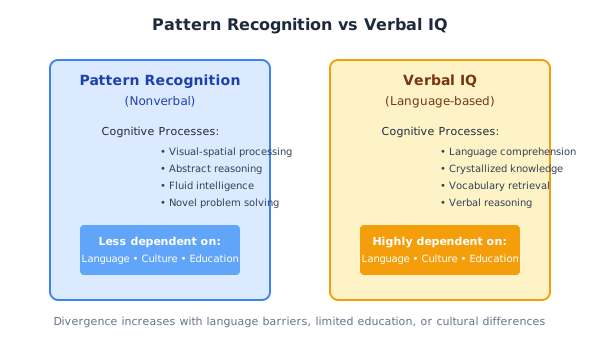
Pattern recognition subtests assess fluid intelligence—your ability to solve novel problems without relying on acquired knowledge. Tasks include matrix reasoning (identifying the missing piece in a visual pattern), block design (arranging blocks to match a pattern), and visual puzzles (assembling pieces mentally to form a whole).
These tasks engage visual-spatial processing, abstract reasoning, and the ability to identify relationships between elements. Crucially, they minimize language demands and cultural knowledge requirements, making them theoretically more culture-fair than verbal measures (Raven, 2000).
Verbal IQ Components
Verbal IQ subtests assess crystallized intelligence—knowledge accumulated through education and life experience. Core tasks include vocabulary (defining words), similarities (identifying conceptual relationships), comprehension (explaining social conventions and proverbs), and information (general knowledge questions).
These tasks depend heavily on language proficiency, educational exposure, and cultural familiarity. Someone who speaks English as a second language or had limited educational opportunities faces inherent disadvantages on verbal subtests regardless of their underlying reasoning ability (Flanagan & Harrison, 2012).
Evidence from Recent Research
How Common Is Score Divergence?
Subtest scatter—variation across different IQ subtests—is remarkably common. Research on the WAIS-IV (Wechsler Adult Intelligence Scale) shows that approximately 25% of examinees have differences of 15 points or more between their highest and lowest index scores. Differences of 8-12 points are found in roughly 50% of the standardization sample (Wechsler, 2008).
The pattern recognition versus verbal IQ split represents one of the most frequent divergence patterns. Across diverse populations, the correlation between nonverbal matrix reasoning and vocabulary subtests typically ranges from r = 0.40 to r = 0.55—a moderate relationship indicating substantial independence between these abilities (Johnson et al., 2004).
Bilingual and Multicultural Populations
Studies of bilingual individuals consistently show elevated pattern recognition relative to verbal IQ when tested in their non-dominant language. Rosselli et al. (2002) found that Spanish-English bilinguals tested in English scored an average of 12 points higher on nonverbal reasoning tasks compared to vocabulary and verbal comprehension subtests.
Even when controlling for language proficiency, cultural factors influence verbal IQ. Questions about social conventions, proverbs, and general knowledge reflect the specific cultural context where the test was developed. Someone from a different cultural background may possess equivalent reasoning ability but lack familiarity with culture-specific content (Shuttleworth-Edwards et al., 2004).
Developmental and Clinical Patterns
Certain learning disabilities produce characteristic split profiles. Individuals with dyslexia often show stronger pattern recognition than verbal IQ due to language processing difficulties that don't affect visual-spatial reasoning. Conversely, those with nonverbal learning disability typically excel at verbal tasks while struggling with visual-spatial problems (Cornoldi et al., 2014).
Autism spectrum conditions frequently involve enhanced pattern recognition alongside average or below-average verbal abilities, though this profile shows considerable individual variation (Dawson et al., 2007). These patterns underscore that intelligence is multifaceted—high ability in one domain doesn't guarantee similar performance in others.
Why Scores Diverge Across Subtests
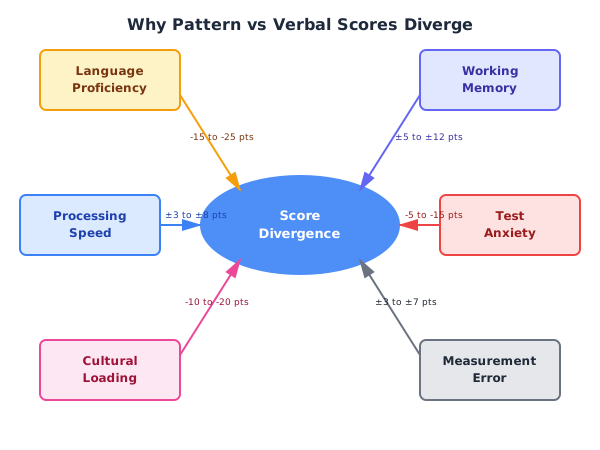
Understanding the specific factors that create pattern recognition IQ vs verbal IQ differences helps interpret your own cognitive profile and recognize the limitations of any single test score.
Language Proficiency and Acquisition
Language proficiency represents the single largest source of verbal-nonverbal discrepancies. Consider Ana, who immigrated to the United States at age 15. She's fluent in conversational English but lacks the extensive vocabulary and idiomatic knowledge that native speakers acquire through years of immersion. On matrix reasoning tasks, Ana performs at the 80th percentile—her pattern recognition ability is strong. But on vocabulary and verbal comprehension subtests, she scores around the 45th percentile.
This 35-percentile gap doesn't reflect limited intelligence. It reflects the reality that crystallized verbal knowledge requires prolonged exposure to a language's nuances. Even highly educated multilingual individuals typically score lower on verbal IQ subtests in their non-native languages, while their pattern recognition scores remain consistent across languages (Ardila et al., 2005).
Working Memory Capacity
Working memory—the ability to hold and manipulate information temporarily—influences both pattern recognition and verbal IQ, but through different pathways. Pattern recognition tasks often require holding visual information in mind while comparing multiple elements. Verbal tasks require maintaining linguistic information while processing semantic relationships.
Individuals with stronger visual-spatial working memory but weaker verbal working memory show the classic pattern recognition > verbal IQ profile. The reverse pattern appears in those with strong phonological loop (verbal working memory) but weaker visual-spatial sketchpad capacity (Kane et al., 2004).
Processing Speed Differences
Processing speed—how quickly you can perceive, process, and respond to information—affects IQ subtest performance but differentially impacts various tasks. Some pattern recognition tasks are heavily timed and reward rapid visual scanning and decision-making. Verbal tasks may be less time-pressured or favor deliberate, thoughtful responding.
Marcus has below-average processing speed (20th percentile) but strong reasoning ability. On untimed or generously timed pattern recognition tasks, he performs well. But on the Wechsler's Block Design subtest—which awards bonus points for speed—his scores suffer. His verbal IQ remains higher because those subtests place less emphasis on rapid responding.
Test Anxiety and Performance Factors
Anxiety affects cognitive performance, but not uniformly across tasks. Some people experience heightened anxiety when facing visual-spatial challenges, while others feel more threatened by verbal evaluation. This differential anxiety produces score discrepancies independent of actual ability.
Jessica reports severe math and spatial anxiety from negative school experiences. When confronting matrix reasoning puzzles, her anxiety spikes, impairing her performance despite having adequate visual-spatial ability. She scores 15 points higher on verbal subtests, where she feels more confident and comfortable. Her pattern recognition IQ underestimates her potential in low-stress conditions.
Cultural Loading and Background Knowledge
Verbal IQ subtests are highly culturally loaded—they assume familiarity with mainstream cultural knowledge, idioms, and social conventions. A vocabulary subtest asks you to define 'diligent' and 'sanctuary'—words common in middle-class educational environments but potentially unfamiliar to someone from a different linguistic or socioeconomic background.
Pattern recognition tasks attempt to minimize cultural loading by using abstract visual stimuli. While not perfectly culture-free (even visual pattern preferences show some cultural variation), they reduce the disadvantage faced by individuals from non-mainstream backgrounds. This explains why immigrants, English language learners, and those from educationally limited backgrounds often show elevated pattern recognition relative to verbal IQ (Suzuki & Valencia, 1997).
Measurement Error and Test Reliability
All psychological tests contain measurement error—your observed score differs somewhat from your 'true' ability due to random factors (fatigue, momentary distraction, lucky guesses, etc.). IQ subtests have standard errors typically around 3-5 points.
When comparing two subtests, their measurement errors compound. A seemingly large 10-point difference between pattern recognition and verbal IQ might result partially from measurement error rather than genuine ability differences. Psychologists use statistical significance testing and confidence intervals to determine whether observed discrepancies exceed what measurement error alone would produce (Sattler, 2008).
Practical Implications
Understanding pattern recognition IQ vs verbal IQ differences has concrete implications for education, career planning, and self-understanding.
Educational Strategies
If your pattern recognition significantly exceeds verbal IQ, you likely learn best through visual demonstrations, diagrams, spatial representations, and hands-on manipulation. Traditional lecture-based instruction may feel frustrating. Seek out STEM fields, visual arts, architecture, engineering, or trades that capitalize on spatial reasoning strengths.
Conversely, strong verbal abilities with weaker visual-spatial skills suggest leveraging reading, discussion, verbal explanation, and linguistic analysis in your learning. Humanities, law, writing, counseling, and verbal communication roles may align better with your cognitive strengths than fields demanding extensive spatial visualization.
Career Alignment
Career satisfaction and success often align with cognitive strengths. Research shows that individuals whose jobs match their ability profiles report higher job satisfaction and perform better (Lubinski & Benbow, 2006). If you discover a marked pattern recognition advantage, consider careers involving:
- Visual design, architecture, or engineering that reward spatial reasoning
- Data visualization and analytical roles requiring pattern detection
- Mechanical or technical fields with hands-on problem-solving
- Mathematics and physics, which heavily engage abstract visual reasoning
- Surgery, radiology, or other medical specialties with spatial demands
Strong verbal abilities suggest different career paths: writing, teaching, law, counseling, journalism, and roles requiring persuasive communication or verbal analysis.
How to Interpret Your Own Results
If you've taken a comprehensive IQ test like the Gifted Entry Test and notice pattern recognition versus verbal score differences, here's how to interpret them:
Differences under 8 points: This likely falls within normal variation and measurement error. Most people show some scatter across subtests. Focus on your overall profile rather than small discrepancies.
Differences of 8-15 points: This represents meaningful variation worth considering. Reflect on possible explanations—language background, anxiety patterns, educational experiences, or genuine cognitive strengths and weaknesses. This information can guide learning strategies and career choices.
Differences above 15 points: Large discrepancies warrant careful interpretation. Consider whether language proficiency, cultural factors, or specific learning differences (like dyslexia or nonverbal learning disability) explain the gap. Such pronounced scatter may justify comprehensive neuropsychological evaluation to understand your cognitive profile better.
Ready to discover your cognitive profile across visual and verbal reasoning domains? Take a free AI IQ test to measure your abstract reasoning, spatial intelligence, and visual logic abilities with detailed analytics.
Limitations, Myths, and Ethics
Common Myths About Subtest Scatter
Myth: "Pattern recognition is a purer measure of true intelligence than verbal IQ." Reality: Neither is more "true"—they measure different aspects of cognition. Verbal knowledge and reasoning are genuine intellectual abilities, not contamination. The question isn't which is purer, but which is more relevant for your specific purposes.
Myth: "Large subtest scatter indicates a learning disability or brain dysfunction." Reality: While certain clinical conditions produce characteristic patterns, scatter alone doesn't diagnose anything. Healthy, high-functioning individuals frequently show substantial subtest variation reflecting their unique cognitive profiles and life experiences.
Myth: "You should only count your highest score as your 'real' IQ." Reality: All scores provide valid information about different cognitive abilities. Cherry-picking your highest score ignores meaningful variation in your cognitive profile. Full-scale IQ, when appropriate, provides the most reliable estimate of general intelligence.
Ethical Considerations in Testing
The pattern recognition vs verbal IQ distinction raises important fairness questions. Using verbal-heavy IQ tests for high-stakes decisions (educational placement, immigration, employment) disadvantages individuals from diverse linguistic and cultural backgrounds. This has led to calls for greater use of nonverbal reasoning measures when assessing individuals from non-mainstream backgrounds.
However, completely eliminating verbal assessment also creates problems. Verbal knowledge and reasoning are genuine cognitive abilities that predict academic and occupational success. The solution isn't abandoning verbal assessment but using it appropriately—interpreting scores in context and considering language background when making decisions.
Frequently Asked Questions
Is it better to have high pattern recognition or high verbal IQ?
Neither is inherently better—it depends on your goals and context. High pattern recognition predicts success in STEM fields, design, and technical domains. High verbal IQ predicts success in humanities, law, communication fields, and roles requiring persuasive language use. Ideally, you want both, but most people have relative strengths.
Can I improve my weaker area through practice?
Yes, though the degree depends on what's causing the weakness. If lower verbal IQ reflects limited vocabulary from language learning, reading extensively and studying vocabulary can produce substantial gains. If lower pattern recognition reflects unfamiliarity with spatial puzzles, practice helps. But if the difference reflects fundamental cognitive architecture, gains may be more modest.
Should I mention score discrepancies when applying for gifted programs or jobs?
For gifted programs, providing context can be valuable—explaining that language background or cultural factors may underestimate your abilities in certain areas. For jobs, focus on demonstrating strengths relevant to the position rather than emphasizing test score discrepancies. Concrete achievements and skills matter more than subtest scatter.
Do most people have balanced profiles or scatter?
Most people show some degree of scatter—perfectly flat profiles across all subtests are actually quite rare. Research suggests that about 75% of people have at least one subtest score that differs from their mean by 8+ points. Substantial scatter (15+ point discrepancies) occurs in roughly 25% of the population.
Summary and Next Steps
The pattern recognition IQ vs verbal IQ difference reflects the multifaceted nature of human intelligence. Pattern recognition tasks assess fluid reasoning and visual-spatial abilities with minimal language demands, while verbal subtests evaluate crystallized knowledge heavily influenced by language proficiency, education, and cultural background.
Score divergences are common, meaningful, and often explained by language background, working memory profiles, processing speed differences, test anxiety, cultural factors, and measurement error. Understanding your specific cognitive profile—where you excel and struggle—enables more informed educational, career, and personal development decisions.
Remember that intelligence is not a single number but a rich, multidimensional construct. Embrace your cognitive strengths, understand your challenges, and recognize that diverse ability profiles contribute to human cognitive diversity. Whether you excel at visual patterns or verbal reasoning, both represent valuable forms of intelligence that serve different purposes in work and life.
Curious about your own pattern recognition abilities? Measure your IQ score across abstract reasoning, spatial intelligence, and visual logic with the Gifted Entry Test—designed to minimize language dependence while providing comprehensive cognitive assessment.